Birmingham, 1948: The Revolt That Put the White Segregationist Vote on the Open Market
On the night of July 17, 1948, some six thousand delegates and spectators packed the Municipal Auditorium in Birmingham, Alabama, waving Confederate battle flags and portraits of Robert E. Lee, to found a new political party. They called it the States' Rights Democratic Party. The press called them the Dixiecrats. Their platform did not hide behind abstraction. It stated, in plain print: "We stand for the segregation of the races."
The Dixiecrat revolt lasted one election. Its consequences did not. In four months, the movement demonstrated something that would shape the next half-century of American politics: the white segregationist vote of the Deep South, the bedrock of the Democratic "Solid South" since Reconstruction, could be detached from the Democratic Party the moment that party made civil rights a national commitment. The Dixiecrats proved the vote was movable. The only question left was who would move it. (For the answer, see standing dossier: THE SOUTHERN STRATEGY.)
"We stand for the segregation of the races."
-- PLATFORM OF THE STATES' RIGHTS DEMOCRATIC PARTY, 1948
SOURCE: THIS PAGE, NOTE 1.
I. WHY THEY WALKED
February 2, 1948. President Harry Truman, a Democrat, sent Congress the first comprehensive civil-rights program ever proposed by an American president, drawing on his own commission's 1947 report To Secure These Rights. He asked for a federal anti-lynching law, abolition of the poll tax, a permanent Fair Employment Practices Commission, and an end to segregation in interstate transportation. The white South's Democratic establishment erupted; Southern governors began organizing resistance within days.
July 14, 1948. At the Democratic National Convention in Philadelphia, Minneapolis mayor Hubert Humphrey urged the party to move "into the bright sunshine of human rights," and the convention adopted a strong civil-rights plank over the objections of its Southern wing. Mississippi's entire delegation and half of Alabama's walked off the convention floor.
"into the bright sunshine of human rights"
-- HUBERT HUMPHREY, DEMOCRATIC NATIONAL CONVENTION, PHILADELPHIA, JULY 14, 1948
SOURCE: THIS PAGE, NOTE 4.
July 17, 1948. Three days later: Birmingham. The bolters convened, nominated Governor Strom Thurmond of South Carolina for president and Governor Fielding Wright of Mississippi for vice president, and adopted the platform quoted above. Thurmond, accepting, told the crowd (in a speech preserved on newsreel film) that there were not enough troops in the Army to force the Southern people to end segregation and admit Black Americans into their theaters, swimming pools, homes, and churches. He used a cruder word than "Black Americans." The footage is archived and linked below; this page describes it rather than reprints it.

PHOTO: U.S. SENATE (PUBLIC DOMAIN)
July 26, 1948. Truman answered with Executive Orders 9980 and 9981, desegregating the federal workforce and the armed forces of the United States.
II. WHAT HAPPENED IN NOVEMBER
The Dixiecrats' strategy was not to win the presidency. It was to strip the Deep South's electoral votes from Truman, throw the election to the House of Representatives, and extort the national party into abandoning civil rights.
They carried four states (South Carolina, Mississippi, Alabama, and Louisiana) plus one faithless elector in Tennessee, for 39 electoral votes and roughly 1.2 million popular votes. The mechanics deserve a close look, because they expose how thin the "grassroots revolt" framing is: the Dixiecrats won essentially only where state party machinery placed Thurmond on the ballot as the official Democratic nominee. In Alabama, Truman's name did not appear on the ballot at all. Where white Southern voters had to consciously leave the Democratic line to vote Dixiecrat, they mostly didn't. Not yet. That was the lesson filed away for later: the voters would follow the label, until the label followed the voters.
Truman won anyway. The blackmail failed. The party dissolved after the election.
III. THE LONG TAIL
The Dixiecrat Party died in 1948. Its personnel and its voters did not.
Thurmond returned to the Democratic fold and was elected to the Senate in 1954, the only U.S. senator ever elected by write-in. In 1956, he was among the drafters of the Southern Manifesto, the declaration of resistance to Brown v. Board of Education signed by 101 members of Congress, nearly all of them Southern Democrats. This site records that fact without flinching, because the record is the point. In 1957, Thurmond personally filibustered the Civil Rights Act of 1957 for 24 hours and 18 minutes, still the longest solo filibuster in Senate history.
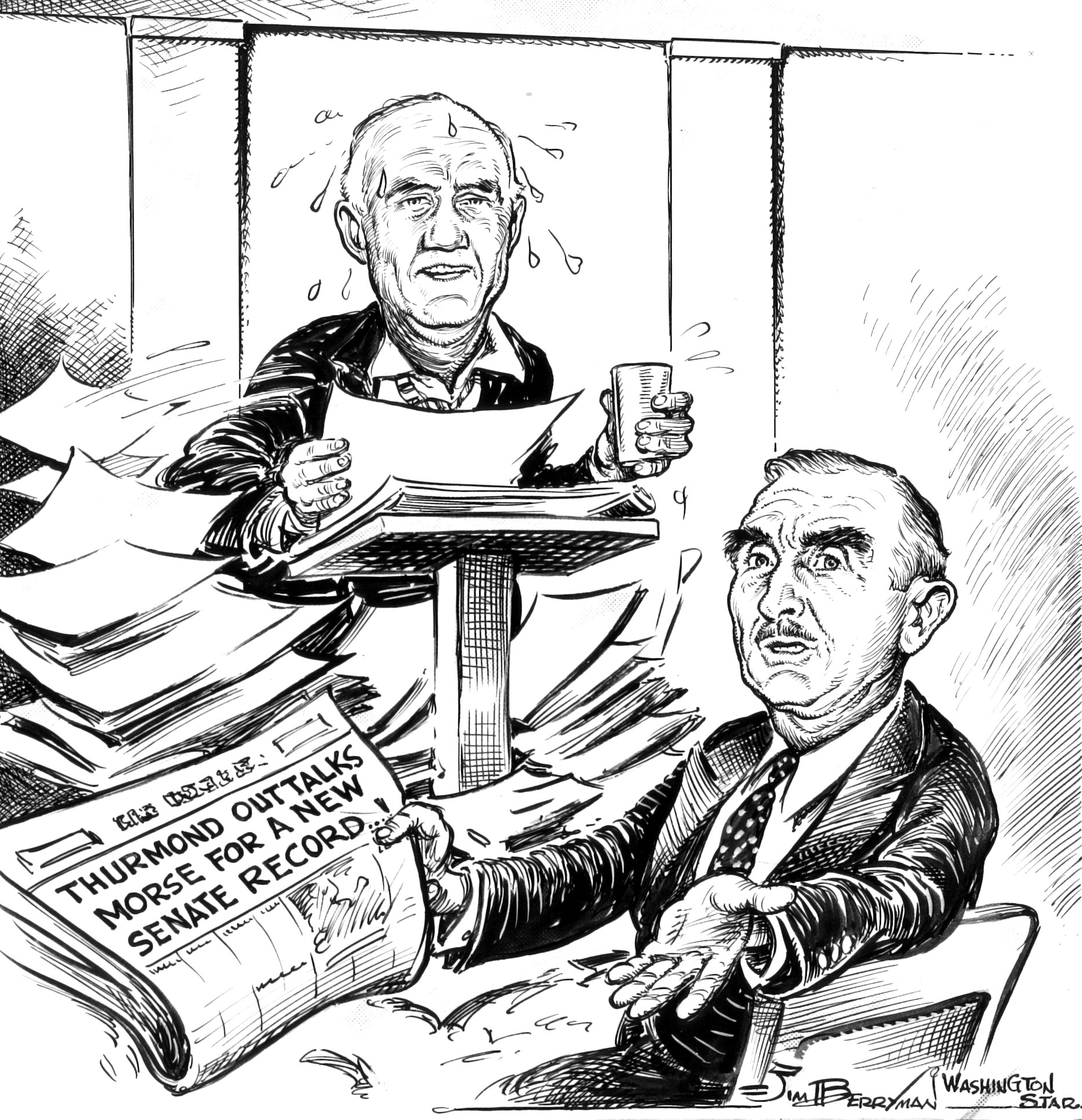
Berryman drew Thurmond's filibuster of the Civil Rights Act of 1957, which ran 24 hours and 18 minutes and is still the longest solo filibuster in Senate history.
CARTOON: U.S. SENATE COLLECTION, OFFICE OF SENATE CURATOR (PUBLIC DOMAIN)
Then, on September 16, 1964 (ten weeks after the Civil Rights Act of 1964 became law, and seven weeks before the election), Thurmond switched parties and became a Republican, campaigning across the South for Barry Goldwater, one of six Republican senators to vote against the Act. The 1948 Dixiecrat standard-bearer spent the remaining 39 years of his career as a Republican, and his political operation, including aide Harry Dent, architect of Nixon's Southern outreach, became infrastructure for the strategy documented in our companion dossier.
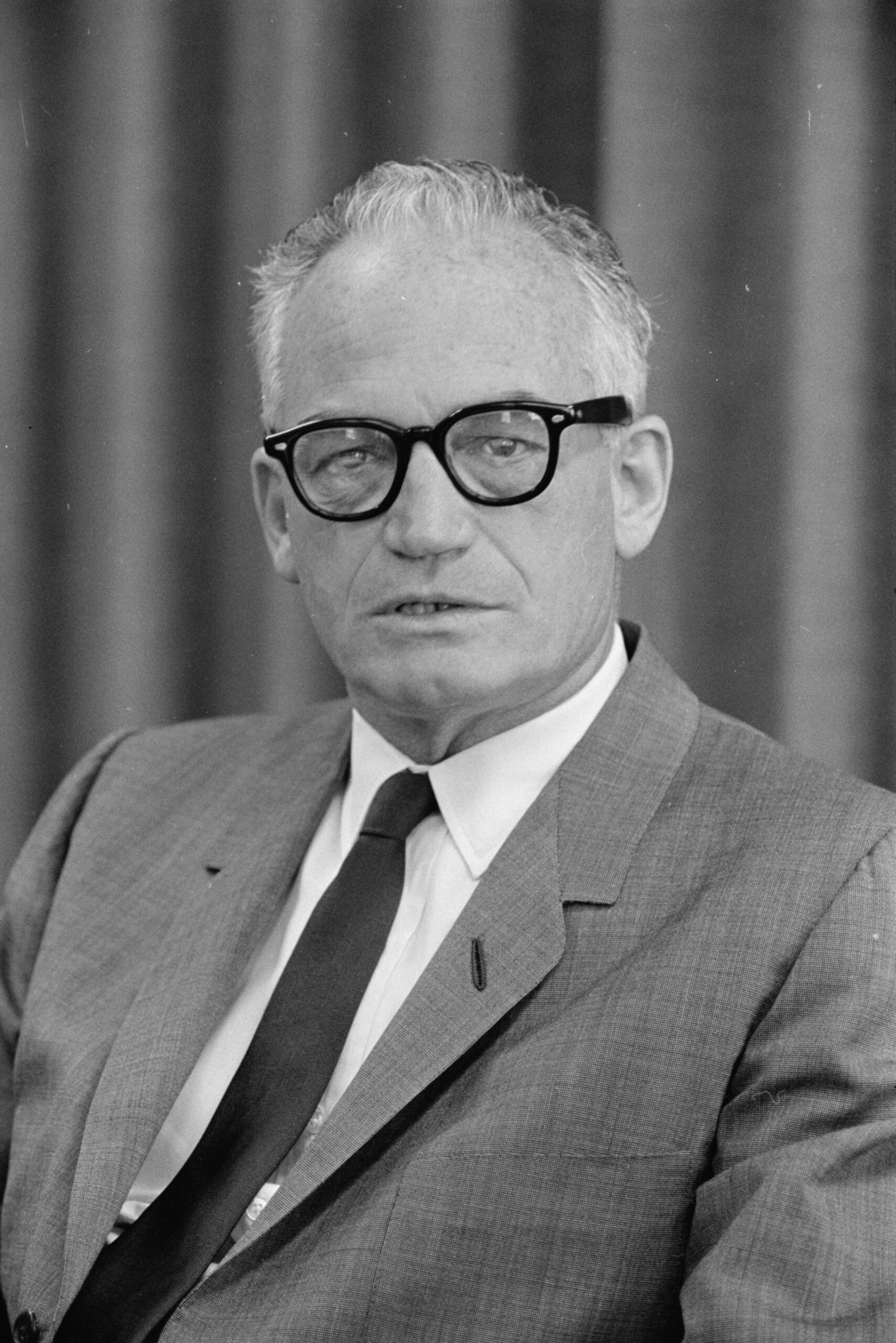
PHOTO: MARION S. TRIKOSKO, U.S. NEWS & WORLD REPORT COLLECTION, LIBRARY OF CONGRESS (PUBLIC DOMAIN)
Lay the maps side by side. The four Dixiecrat states of 1948 (South Carolina, Mississippi, Alabama, Louisiana) reappear, with Georgia, as exactly the five Southern states Goldwater carried in 1964. They anchor the Wallace vote of 1968. They are inside Nixon's sweep of the former Confederacy in 1972. The Dixiecrat revolt was not an endpoint. It was a proof of concept.
IV. THE REBUTTAL FILE
Standing claims, checked against the record.
CLAIM: "The Dixiecrats were Democrats."
THE RECORD: True. Every word of this page documents it. The segregationist South was governed by Democrats for nearly a century, and the Dixiecrats were a revolt within that party. This site's position is not that the Democratic Party's history is clean; it is that the record shows what each party did next, and for whom it went hunting.
CLAIM: "The Dixiecrats went back to being Democrats, so there was no party switch."
THE RECORD: The politicians mostly went back. The voters, over time, did not. Realignment is measured in electorates, not in the party registrations of aging officeholders. The through-line runs from the 1948 Dixiecrat map to the 1964 Goldwater map to the 1972 Nixon sweep, with Thurmond himself, the movement's own presidential nominee, making the switch in person the year the Civil Rights Act passed. The peer-reviewed data (Kuziemko and Washington, American Economic Review, 2018) show white Southern defection from the Democratic Party beginning precisely with the party's 1963–64 civil-rights turn, driven by racial views rather than economics.
CLAIM: "1948 was about states' rights and constitutional principle, not segregation."
THE RECORD: The Dixiecrats themselves said otherwise, in writing. The party's platform named the right being defended: segregation of the races. Its nominee, on film, defined the stakes as keeping Black citizens out of white theaters, pools, homes, and churches. "States' rights" was the container; the platform helpfully printed the contents. The phrase's later career as a euphemism (through 1961, 1968, and a 1980 campaign kickoff in Neshoba County, Mississippi) is documented in the companion dossier.
V. QUESTIONS, ANSWERED FROM THE RECORD
Who were the Dixiecrats?
The States' Rights Democratic Party: Southern Democrats who bolted their party over its 1948 civil-rights plank. They convened in Birmingham, Alabama, on July 17, 1948, and nominated Governor Strom Thurmond of South Carolina for president and Governor Fielding Wright of Mississippi for vice president. Their platform stated: "We stand for the segregation of the races." (Sources: notes 1 and 5.)
Why did the Dixiecrats leave the Democratic Party?
Civil rights. On February 2, 1948, President Truman sent Congress the first comprehensive civil-rights program ever proposed by a president: a federal anti-lynching law, abolition of the poll tax, a permanent Fair Employment Practices Commission and an end to segregation in interstate transportation. On July 14 the Democratic convention adopted a strong civil-rights plank, and Mississippi's entire delegation and half of Alabama's walked off the floor. (Sources: notes 2 and 4.)
How many states did the Dixiecrats win in 1948?
Four: South Carolina, Mississippi, Alabama and Louisiana, plus one faithless elector in Tennessee, for 39 electoral votes and roughly 1.2 million popular votes. They won essentially only where state party machinery put Thurmond on the ballot as the official Democratic nominee. Truman won anyway. (Sources: notes 7 and 8.)
Was the Dixiecrat revolt about states' rights or segregation?
The Dixiecrats answered that themselves, in writing. Their platform named the right being defended: "the segregation of the races." Thurmond, accepting the nomination on film, defined the stakes as keeping Black Americans out of white theaters, swimming pools, homes and churches. (Sources: notes 1 and 5.)
Did Strom Thurmond become a Republican?
Yes. On September 16, 1964, ten weeks after the Civil Rights Act of 1964 became law and seven weeks before the election, the 1948 Dixiecrat nominee switched parties and campaigned across the South for Barry Goldwater. He spent the remaining 39 years of his career as a Republican. (Source: note 12.)
Did the Dixiecrats become Republicans?
The politicians mostly went back to the Democratic Party. The voters, over time, did not. The four Dixiecrat states of 1948 reappear, with Georgia, as exactly the five Southern states Goldwater carried in 1964, and the survey data show white Southern defection from the Democrats beginning with the party's 1963–64 civil-rights turn, driven by racial views rather than economics. (Source: note 13. See standing dossier: THE SOUTHERN STRATEGY.)
VI. A NOTE ON WHAT THIS PAGE IS NOT
This is not a claim that every white Southerner of 1948 was a Dixiecrat, nor that the Democratic Party of that era deserves defending. It doesn't, and our Jim Crow dossier says so at length. This is a documented account of a specific event: the moment the segregationist vote announced, in its own platform and its own nominee's voice, exactly what it wanted and that it was available to any party willing to provide it.
SOURCES -- THIS PAGE
- Platform of the States' Rights Democratic Party, adopted at Oklahoma City, August 14, 1948 (drafted following the Birmingham convention); full text via The American Presidency Project, U.C. Santa Barbara.
- Harry S. Truman, Special Message to the Congress on Civil Rights, February 2, 1948; Truman Library.
- To Secure These Rights: The Report of the President's Committee on Civil Rights (1947).
- Hubert H. Humphrey, address to the Democratic National Convention, Philadelphia, July 14, 1948; convention proceedings and contemporaneous coverage.
- Contemporaneous coverage of the Birmingham convention, July 17–18, 1948: Associated Press; The Birmingham News; Universal Newsreel footage of Thurmond's acceptance speech (archived; audio survives).
- Executive Orders 9980 and 9981, July 26, 1948; National Archives.
- 1948 presidential election returns; state canvasses and Congressional Quarterly compilations.
- Kari Frederickson, The Dixiecrat Revolt and the End of the Solid South, 1932–1968 (University of North Carolina Press, 2001). The standard scholarly account, including ballot-line mechanics.
- Joseph Crespino, Strom Thurmond's America (Hill and Wang, 2012).
- The Southern Manifesto ("Declaration of Constitutional Principles"), Congressional Record, March 12, 1956.
- Congressional Record, August 28–29, 1957 (Thurmond filibuster of the Civil Rights Act of 1957).
- Thurmond party switch, September 16, 1964; contemporaneous coverage, The New York Times and The State (Columbia, S.C.).
- Ilyana Kuziemko and Ebonya Washington, "Why Did the Democrats Lose the South? Bringing New Data to an Old Debate," American Economic Review 108(10), 2018.