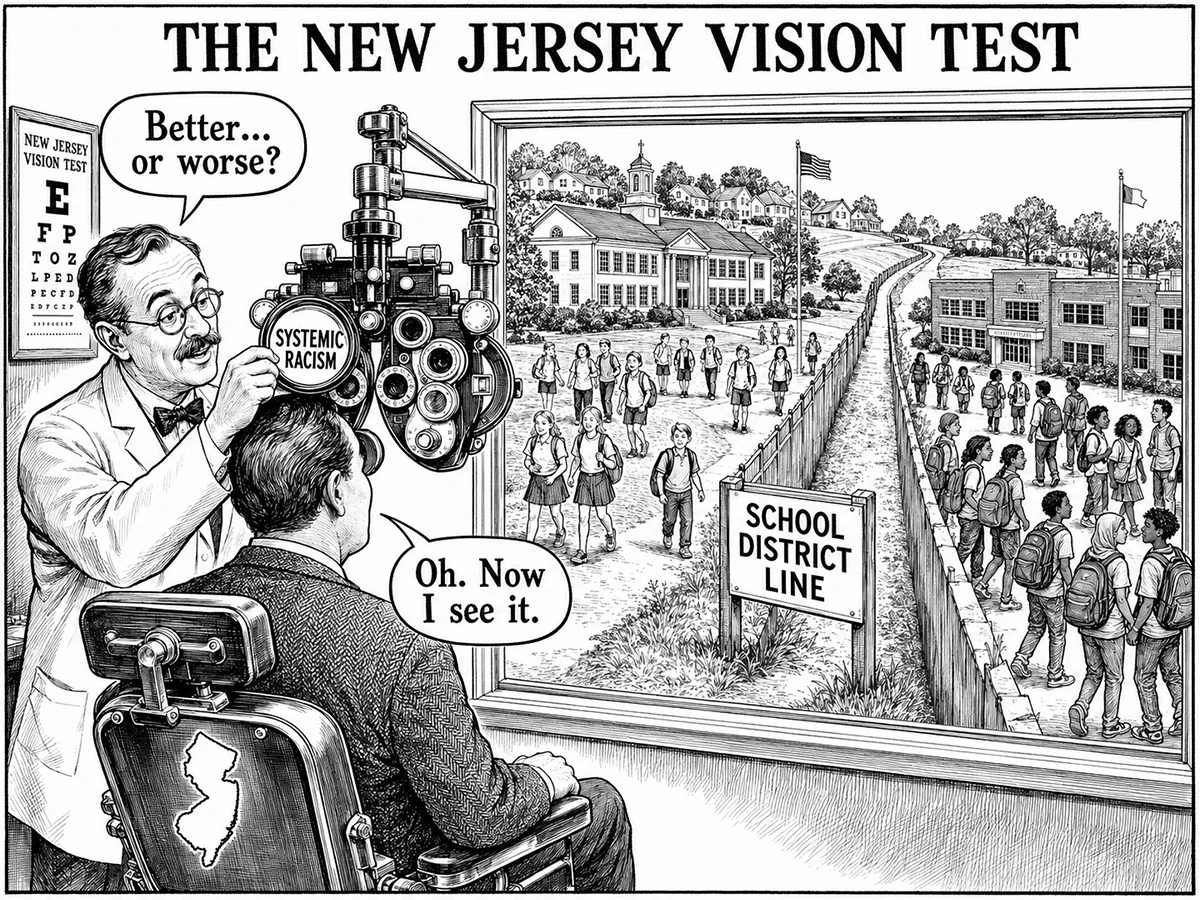
In New Jersey towns where one resident in a hundred is Black, 68 percent of voters say the local schools have "a good mix" of races. Eleven percent say the schools are segregated.
That is from a survey experiment released on July 27, 2026 by the Fairleigh Dickinson University Poll, which did something nobody had done before in this state: it took what registered voters said about their own towns and laid it directly against the Census composition of those towns. The result is not a story about people being misinformed. It is a story about people declining to see something that is in front of them, and the study includes an experiment that shows what it takes to make them look.
I. THE NUMBER THAT WILL NOT MOVE
Start with the finding that makes the rest of the study make sense.
Take a New Jersey town that is majority non-white. Six percent of voters there say their schools are segregated. Now take a town that is 90 percent white or more (an enormous change in the actual composition of a place, roughly the difference between Camden and a Sussex County borough). The number goes to nine percent.
That is the whole range. Three points, well inside the poll's margin of error, across the entire spectrum of segregation the state has to offer. Whatever New Jersey voters are answering when you ask them whether their schools are segregated, it is not a question about their schools.
Source: FDU Poll release tables, June 23-30, 2026. N=1,211 registered voters. Margin of error +/-4.2 points including design effects.
The mirror-image number is just as flat. In majority-minority towns, 81 percent say there is "a good mix." In towns that are 90 percent white, that falls to 73 percent. Eight points. A town can go from majority Black and Hispanic to nine-in-ten white and roughly three quarters of the people living there will describe the schools the same way.
II. WHERE PEOPLE ACTUALLY LIVE
The FDU Poll linked each respondent's zip code to 2020 Census data, so for the first time the "what do you see" answers sit next to the "what is there" numbers. What is there:
- The median white voter in New Jersey lives in a town that is 62 percent white and 11 percent Black.
- The median Black voter lives in a town that is 31 percent white and 34 percent Black.
- The median Hispanic voter lives in a town that is 39 percent white, 17 percent Black and 33 percent Hispanic.
Medians hide the tail, and the tail is the point. Just under 40 percent of white voters in New Jersey live in a municipality that is three percent Black or less. About 10 percent live somewhere that is one percent Black or less. These are not statistical curiosities. That is one white voter in ten living in a town where, functionally, no Black families live.
Two thirds of the people in those towns will tell a pollster the schools are a good mix.
"What people say about segregation is less about what people are seeing around them, and more about what they would like to believe. If they admitted there was segregation, they might have to do something about it, so it's easier to pretend it isn't happening."
-- PETER WOOLLEY, DIRECTOR EMERITUS, FDU POLL
Dan Cassino, who runs the poll, put the same thing more gently. "Even in the whitest areas, people know that segregation is bad," he said, "so they don't want to recognize how bad the problem is."
III. THE VISION TEST
Here is where the study stops being a poll and starts being an experiment.
Every respondent got the same questions. What changed, at random, was the order. One third got harmless filler first (self-serve gas stations, pet tax credits, whether movie theaters should sell liquor) and then the segregation questions. One third were asked what makes something racist, and then the segregation questions. One third were asked about their politics first.
Nothing else was different. No new information was supplied. Nobody was shown a map, a statistic, or a photograph of their own school district. The only variable was what the respondent had been thinking about ninety seconds earlier.
Across all voters, it did essentially nothing. Nine percent said "segregated" in the control condition, nine percent in the racism condition. The partisan condition did nothing consistent anywhere in the study.
But the study was not really looking for an average. It was looking for the people carrying a contradiction: white voters living in the whitest quarter of New Jersey towns who already say that racism can happen without anyone intending it. People whose stated principles and stated surroundings do not fit together.
Ask that group about racism first, and this happens.
Asked cold (control)Asked after a question about racism
Source: FDU Poll release tables, June 23-30, 2026. Subgroup: white voters in municipalities in the top quartile for percent white (80%+) who say racist outcomes can occur without racist intent. The merger result was not reported as significant.
Nearly triple the number recognizing segregation in their own schools. Nineteen points on magnet schools. Sixteen on transfers. Twelve on busing, which has been the third rail of American education politics for fifty years.
Nothing was disclosed to these people. They were asked a question about racism in the abstract, and then asked what their town looks like, and a chunk of them gave a different answer than they would have given four minutes earlier.
Among white voters in the same towns who say racism requires racist intent, there was no significant increase. The lens only works if you are already wearing the prescription.
"People are able to recognize the disconnect between their own principles and what they're seeing around them. The problem is that they're just not being asked to do so."
-- DAN CASSINO, EXECUTIVE DIRECTOR, FDU POLL
IV. WHAT THEY WILL AGREE TO
The poll offered four remedies. Two are gentle: let students transfer between districts more easily, build regional magnet schools. Two are not: bus students across district lines, force districts to merge. Support falls almost exactly in that order.
Source: FDU Poll release tables, June 23-30, 2026. N=1,211 registered voters.
The gap by race is wider than the gap between the policies. Thirty-six percent of white voters would back forced district mergers; 70 percent of Black voters would. Sixty-six percent of white voters want easier transfers; 87 percent of Hispanic voters do. The people who would have to be bused are, consistently, the people most willing to do it.
And within white voters, support drops as the town gets whiter. In municipalities under 45.6 percent white, 45 percent of white voters back mergers. In the whitest quartile, 32 percent do. Willingness to integrate is lowest exactly where integration would have to happen.
"In the long term, merging districts is probably the best way to reduce school segregation. But it seems like no degree of pointing out ideological inconsistencies is going to get New Jersey voters to agree to that."
-- DAN CASSINO
V. THE FAULT LINE
Underneath all of it is one question, and the FDU Poll asked it plainly: can something be racist if nobody intended it?
Fifty-two percent of New Jersey voters say yes, racism can be systemic. Thirty-nine percent say it requires intent. There is no meaningful difference between white, Black and Hispanic respondents on this -- 51, 56 and 52 percent respectively say racism can happen without intent, all inside the margin of error of each other.
By party, it is a canyon.
Racism requires intentRacism can happen without intent
Source: FDU Poll release tables, June 23-30, 2026. Remainder in each row answered "not sure."
Thirty-four points, on the definition of the word. This is why the same set of facts produces two irreconcilable readings of New Jersey. If racism requires a racist, and no New Jersey official ever signed an order segregating a school, then the schools cannot be segregated -- they merely came out that way. Cassino states the syllogism without editorializing: "People recognize that school segregation is a racist outcome, so if you believe that racist outcomes can only arise from racist intent, you might decide that what's happening in New Jersey schools can't actually be segregation."
Woolley is blunter. "Basically every argument about racism in America comes down to the question of whether racism requires intent," he said. "This is the fault line of racial politics in America."
(That question now has its own standing dossier: THE INTENT STANDARD.)
VI. IN FAIRNESS: THIS IS NOT A REPUBLICAN STORY
THE OBVIOUS OBJECTION: "You run a site called Republicans are Racists. Of course you like a study about racism."
THE RECORD: Then read the numbers, because they do not flatter anybody. New Jersey has not voted for a Republican president since 1988. Forty-four percent of this sample are Democrats and 37 percent are Republicans. Nine percent of the whole state says its schools are segregated, which means the denial is running at scale in a solidly Democratic state, in towns that vote blue, among voters who tell pollsters that racism can be systemic. Among Democrats specifically, eight percent say their schools are segregated -- no better than the statewide number, and Democrats are likelier than Republicans to live in the diverse towns where that answer would actually be defensible.
It gets worse for that objection. Democrats statewide back forced district mergers at 56 percent. Democrats living in towns that are 80 percent white or more back them at 17 percent. Busing goes from 49 percent to 19. Those same Democrats in white towns are the likeliest group in the entire study to say their local schools are segregated (13 percent, higher than any other cut FDU published). They can see it. They are the least willing in the state to do anything about it.
The one place the parties genuinely part company is the definition of racism, and we have printed that gap above rather than buried it. Everything else here is a story about New Jersey.
VII. TWO TABLES THAT COME WITH A WARNING LABEL
Buried in the release tables, and discussed nowhere in the release itself, are the two party-by-town cuts below. FDU did not present either as a finding. We are printing them anyway, with the reason for the caution attached, because one of them is the most interesting number in the study and the other is the most suspicious.
| Support for... | All Democrats | Democrats in towns 80%+ white | All Republicans | Republicans in towns 80%+ white |
|---|---|---|---|---|
| Say their schools are segregated | 8% | 13% | 9% | 6% |
| Force districts to merge | 56% | 17% | 25% | 52% |
| Bus students between districts | 49% | 19% | 29% | 43% |
| Easier transfers between districts | 82% | 49% | 60% | 76% |
| Regional magnet schools | 67% | 37% | 45% | 68% |
The left-hand collapse is believable. Democrats who move to a town that is nine-tenths white generally moved there for the schools, and the tables show them behaving exactly like people protecting an asset: highest recognition of segregation in the state, lowest willingness in the state to merge a district. Every other number in the study points the same direction -- white support for mergers falls steadily as the town gets whiter, from 45 percent in the least-white quartile to 32 percent in the whitest. This cut is that trend, sharpened.
The right-hand column is the one to distrust, and we would say so if it cut the other way. It reports Republicans in the whitest towns backing forced district mergers at 52 percent, against 25 percent for Republicans generally and 32 percent for white voters in those same towns. Republicans are overwhelmingly white. A subgroup cannot sit 20 to 27 points above both of the populations it is drawn from unless it is small and the estimate is noisy. Split that subgroup three ways again by experimental condition, as the release does to produce a 33-to-61 swing on mergers, and you are reading cells of a few dozen people with a margin of error wide enough to drive a school bus through.
FDU said the partisan condition had no consistent effect and confined its own claims to the systemic-racism subgroup. They were right to. A number that flattering to a narrative is exactly the kind you should check twice, and the check fails.
VIII. WHAT THIS SHOWS, AND WHAT IT DOESN'T
This is a survey experiment, which is built to establish causation inside the sample rather than to describe the state precisely. FDU says so itself, and says it in the methodology rather than in a footnote nobody reads, which is more than most outfits manage. The survey went to 1,211 registered voters by text-to-web between June 23 and 30, 2026, in English only. Simple margin of error is +/-3.0 points; including design effects of about 1.4, it is +/-4.2. Town composition was assigned by linking zip codes to 2020 Census data, so a respondent in Upper Montclair is counted as Montclair, with the error that implies.
The experimental effects are real but narrow. Widen the subgroup from the whitest quarter of towns to the whitest half and the effect largely disappears. This is a finding about a specific group of people in a specific corner of one state, and anybody selling it as a national persuasion strategy is selling something.
What it does show is harder to wave off: that in the most segregated communities in a state whose school segregation the UCLA Civil Rights Project has ranked among the worst in the country, the barrier to seeing the problem is not information. Those voters could see it. They saw it the moment somebody made them think about racism for ninety seconds. Then they were willing to bus their children.
IX. MEANWHILE, IN COURT
None of this is happening in a vacuum. Latino Action Network v. State of New Jersey was filed in 2018 by the Latino Action Network, the NAACP New Jersey State Conference and a coalition of families. In October 2023 a trial judge found "marked and persistent racial imbalance" in the state's schools while stopping short of declaring the whole system unconstitutional. Mediation ran into early 2025 and produced nothing. The appellate division granted leave to appeal in July 2025. In May 2026 the state Supreme Court declined to fast-track it. Eight years in, there is no hearing date.
Which is roughly what you would expect in a state where 91 percent of voters decline to describe their own schools as segregated. Woolley: "We can fix school segregation, and it isn't like we don't know what can be done. But we can't do anything to fix it unless people can agree that there's something that needs to be fixed."
The study's most quotable line is also its least comfortable, because it is not an accusation. It is an offer. The people in those towns are not being lied to and they are not stupid. They are, in Cassino's words, "just not being asked."
Somebody should ask them.
SOURCES -- THIS PAGE
- "Experiment Shows What's Needed to Get Voters to See Segregation in New Jersey," FDU Poll, Fairleigh Dickinson University, July 27, 2026. Full release, methodology statement, question wording and release tables. All figures and quotations on this page are from this release.
- FDU Poll methodology: fielded June 23-30, 2026 by Braun Research of Princeton, N.J.; text-to-web to cellular phones; 1,211 registered New Jersey voters; English only; weighted on sex, age, education, region and race/ethnicity via SPSSINC RAKE; design effects approximately 1.4; margin of error +/-3.0 points simple, +/-4.2 including design effects. FDU Poll is a member of the AAPOR Transparency Initiative.
- Gary Orfield et al., New Jersey's Segregated Schools: Trends and Paths Forward, The Civil Rights Project, UCLA (2017), which ranked New Jersey among the most segregated school systems in the country.
- Latino Action Network v. State of New Jersey, ACLU of New Jersey case file; October 2023 trial ruling finding "marked and persistent racial imbalance"; mediation concluded without agreement, early 2025.
- "The Status of Latino Action Network v. State of New Jersey," New Jersey School Boards Association, on the July 2025 grant of leave to appeal and the current posture of the case.
- "NJ Supreme Court Won't Fast-Track School Segregation Lawsuit," Central Jersey, May 15, 2026.
Write to the Editor