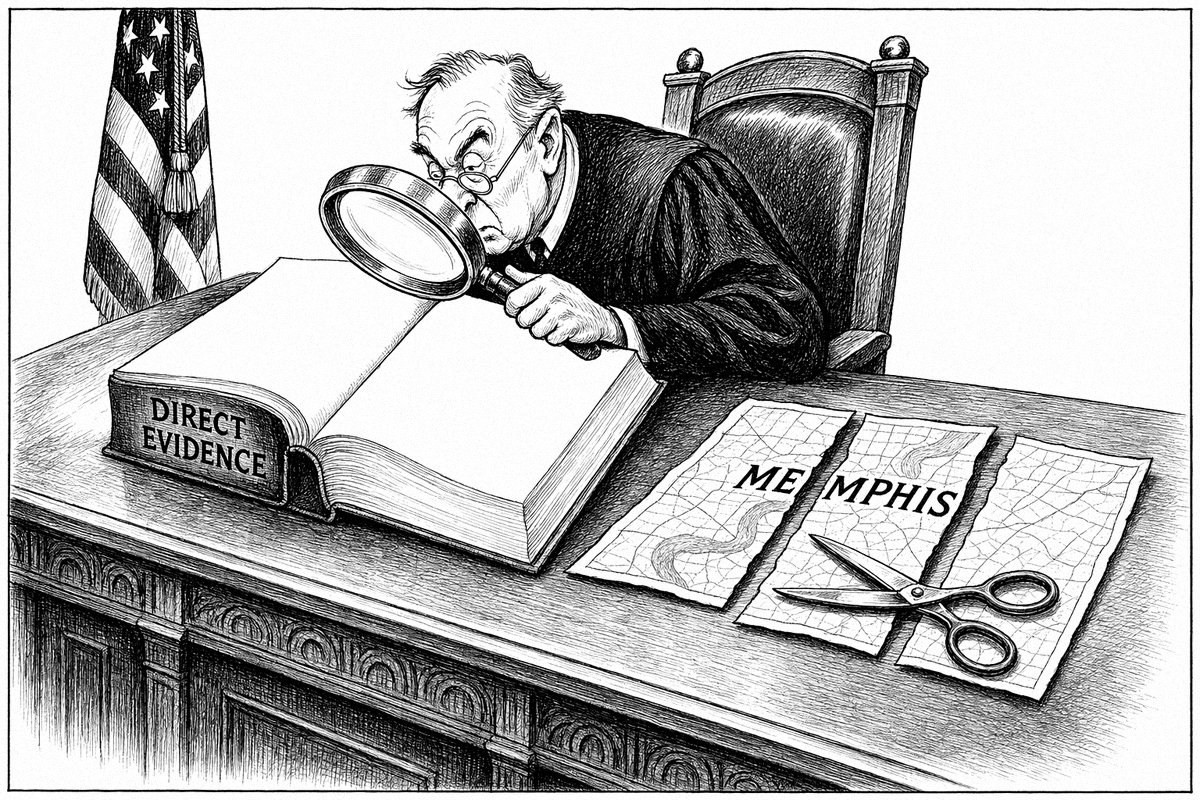
On April 29, 2026, the Supreme Court decided Louisiana v. Callais and told states they can almost never consider race when drawing maps to comply with Section 2 of the Voting Rights Act. Tennessee is one of eight Republican-controlled states that have taken up mid-decade redistricting since, by the Associated Press's count. Tennessee moved fast.
Since 1972, Tennessee law had said the congressional map gets drawn once after each census and that "the districts may not be changed between apportionments." In a May 2026 special session, the General Assembly repealed that 54-year-old ban on itself, then used the repeal the same week. The new map splits Memphis and Shelby County, which had sat inside a single district since before Baker v. Carr, into three.
I. WHAT THE MAP DID
District 9 was Tennessee's only majority-Black congressional district: 61.1 percent Black voting-age population by the 2020 census. It had never been drawn under a court order, and no court had ever held it was drawn predominantly on race. It was simply the district Memphis lived in.
BeforeAfter
Source: Black voting-age population. The 61.1 percent figure is from the 2020 Census PL 94-171 file for Tennessee, as pleaded in the complaint in Sherman v. Hargett. The 27, 28 and 32 percent figures are the ones witnesses and legislators read into the record during the May 2026 extraordinary session; no sponsor of the map disputed them.
Look at the bottom three bars again. Twenty-seven, twenty-eight, thirty-two. The plaintiffs' expert ran the same arithmetic a second way, on Memphis rather than the districts, and it came out cleaner still: District 5 receives 39.7 percent of the city's Black voting-age population and District 9 receives 39.8 percent. Two districts, 115,383 people and 115,635 people, a gap of 252.
The complaint calls that "mathematical precision." The word that comes to mind is tidier: someone was measuring something.
Rep. Steve Cohen had held the seat for nineteen years. On May 15 he announced he would not run in any of the three districts, and said why: "Last week, Tennessee Republicans silenced the Black vote here in Memphis to make Republican victories likely." He left himself one door. "We are still fighting, and if we prevail in the courts and the 9th District remains intact, I will remain a candidate."
II. WHAT THE COURT HELD
They did not prevail. On July 23, six days after early voting had already opened, a three-judge panel convened under 28 U.S.C. § 2284 denied the preliminary injunction in Sherman v. Hargett. The panel: District Judge Gregory Stivers, an Obama appointee, and two Trump appointees, Circuit Judge John Nalbandian and Chief District Judge William Campbell. The opinion is per curiam and there is no dissent.
Tennessee's defense was not that the map treats Black Memphians fairly. Tennessee's defense was that it was aiming at Democrats. State Sen. John Stevens said so on the floor: "This bill represents Tennessee's attempt to maximize our partisan advantage." The state told the court it had drawn the districts on population and politics, "that is, without using racial data," specifically to reduce the risk of a lawsuit.
The court agreed, and did the arithmetic that makes the defense airtight. Memphis holds roughly 610,000 people. A Tennessee congressional district holds 768,000. The city votes Democratic by about fifty points, which means Memphis can carry a Democrat to Congress no matter what rural territory you staple to it. Therefore:
"As a result, the road to a reliably 9-0 map runs through Memphis. Thus, political motivations readily explain the map's dilutive effects."
-- SHERMAN v. HARGETT, ORDER DENYING PRELIMINARY INJUNCTION, JULY 23, 2026
SOURCE: THIS PAGE, NOTE 2.
Read that as a sentence about Black voters and it says something strange: the only reason to break up Memphis is politics, and the reason Memphis is politically decisive is that Memphis votes as a bloc, and the bloc is 61 percent Black. The court is not hiding this. It is holding that the overlap is the plaintiffs' problem to solve, not the state's. Under Callais, challengers must "rul[e] out the competing explanation that political considerations dominated," and "if either politics or race could explain a district's contours," they lose.
Either. Not both, not predominantly. Either.
So the panel's finding is not that Tennessee had no racial motive. It is that the plaintiffs "lack any direct evidence of racial motivation," which is a different claim entirely, and the one this archive keeps a standing dossier on. The opinion reaches for McCleskey v. Kemp for the proposition that old official acts can't prove current intent. McCleskey is where a statistical showing of racial disparity in death sentencing lost because it could not produce a confession. Forty years later it is doing the same work in Nashville.
III. THE FOOTNOTE
Here is the part worth printing out. In footnote 3, the panel stops litigating and describes the machine it is operating.
"Our reapportionment doctrine triggers a strange game between Republican and Democratic legislators. ... And the majority party, aware that any mention of race could invalidate the map, coaches its legislators to stay quiet. But here, Republican legislators said nothing about race during the entire redistricting process. So it seems strange for Plaintiffs to hold this against them. Surely, not mentioning race isn't evidence of racial animus."
-- SHERMAN v. HARGETT, FOOTNOTE 3
SOURCE: THIS PAGE, NOTE 2.
A federal court has written down, in a published opinion, that the law rewards a party for coaching its members not to say the thing, and then ruled that the coaching worked. The silence is not evidence of animus. Correct. It is evidence that everyone involved knows precisely which word costs money.
Footnote 4 finishes the thought. The plaintiffs argued that redrawing the map within weeks of Callais showed what the legislature was thinking about. The panel agreed on the timing and disagreed on the inference: the rush shows only that "the legislature thought it could avoid considering race in light of Callais," which the court calls "a far cry from using race to draw districts." The opinion also notes, without alarm, that the short gap between Callais and the primary "appeared to give the state a brief window."
A window. Everyone in the room understood what had just become legal, and how long they had to do it.
IV. THE ARCHIVE, ENTERED INTO EVIDENCE AND RULED OUT
Paragraph 40 of the complaint does what this site does. It lists what Tennessee Republicans have said out loud: a 2016 bill sponsor describing white and Black students as "light meat" and "dark meat," a 2018 representative advertising his hometown as the birthplace of "the first white baby in the state of Tennessee," a 2019 speaker's chief of staff texting that "black people are idiots," a 2020 member explaining that a Black colleague was distracted looking for a fried chicken recipe.
The first entry on that list is Rep. Sheila Butt, who in 2015 proposed that white people needed an "NAAWP." This archive filed her two days after she said it, eleven years ago. She turns up in footnote 5, and the court's answer is procedural and, on its own terms, fair: Butt and the others left the legislature years ago, so their remarks "shed no light on the current legislature's disposition."
Which leaves the one man on the list who is still there. In 2023, during a committee hearing on execution methods, Rep. Paul Sherrell asked "could I put an amendment on that it would include hanging by a tree, also?" When Rep. Justin Pearson responded by reading the names of people lynched in Shelby County, the speaker cut off his microphone. The panel's treatment: "one insensitive and regrettable remark," from a legislator whose words can't be attributed to the body, three years old, and apologized for.
Every individual ruling here is defensible. That is the whole point. Butt is gone, so she doesn't count. Sherrell is one man, so he doesn't count. The current legislature said nothing at all, so there is nothing to count. The map divides a 61 percent Black city into thirds that differ by 252 people, and no piece of evidence survives contact with the standard on its own.
This is the same machinery the archive watched run in Los Angeles last week, where the government's own numbers showed a sixfold rise in detentions of Latinos with no criminal record and the answer was that nobody had proved the intent. Different agency, different statute, one rule: outcomes are not evidence, and the only admissible proof is a confession nobody has any reason to make.
Tennessee votes Thursday. Nine districts, not one of them majority-Black, and Black Memphians now a minority in all three of the districts their city was cut into. The plaintiffs are still litigating for permanent relief, which will arrive, if it arrives, after the ballots are counted. Plaintiff Amber Sherman's line is the one to keep: "We deserve the same opportunity to shape our future as anyone else."
They said nothing about race, and got a map that says it for them. File it under: things that keep happening by pure coincidence.
SOURCES -- THIS PAGE
- Louisiana v. Callais, decided April 29, 2026: the opinion (PDF); NBC News on what it changed.
- Sherman v. Hargett, No. 3:26-cv-00616 (M.D. Tenn.), order and opinion denying preliminary injunction, July 23, 2026 (PDF). All quotations from the panel, including footnotes 3, 4 and 5, are taken from that document. Panel: Stivers, District Judge; Nalbandian, Circuit Judge; and Campbell, Chief District Judge; per curiam.
- The complaint (PDF), for the 61.1 percent figure (para. 28), the 1972 mid-decade redistricting ban at Tenn. Code § 2-16-102 (paras. 31-32), the 27/28/32 percent figures read into the session record (para. 66), the 39.7/39.8/20.5 percent division of Memphis's Black voting-age population (para. 94), and the legislators' remarks at para. 40.
- ACLU on the ruling, including Amber Sherman's statement; The Hill and the Associated Press via U.S. News for the panel's composition, the August 6 primary date and the count of states redrawing mid-decade.
- Rep. Steve Cohen's May 15, 2026 statement ending his campaign: Tennessee Lookout. State Sen. John Stevens on maximizing partisan advantage: ABC News on the map's passage.
- Rep. Paul Sherrell's 2023 remark and apology: Associated Press. Rep. Sheila Butt's 2015 "NAAWP" post: Nashville Scene, and this archive's entry from February 27, 2015.
- On the standard the panel applied, this site's Intent Standard dossier, including McCleskey v. Kemp (1987), which the opinion cites.
Write to the Editor