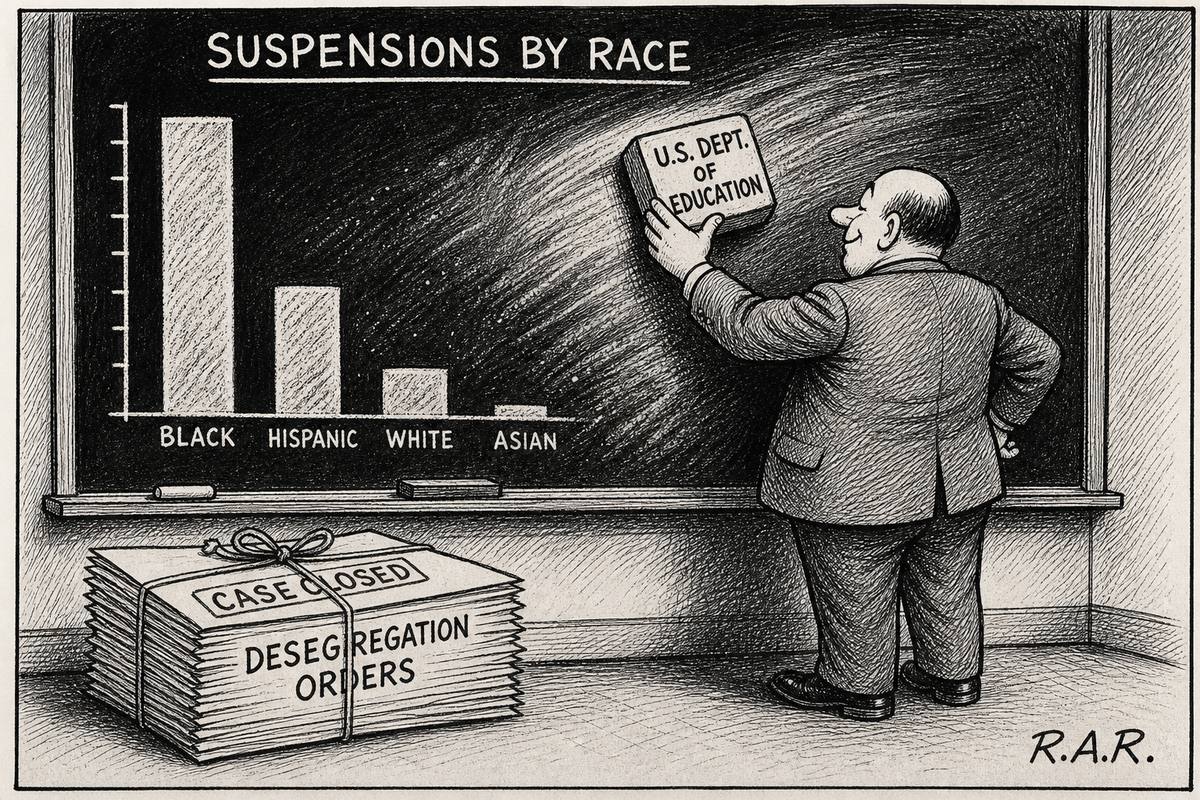
Most entries in this roll call have a quote at the center: somebody said the thing. This one doesn't. The administration has figured out the quieter version, which is to stop looking.
The Associated Press laid out the pieces on September 25. Here they are in order.
I. THE RULE
In May 2025, President Trump signed an executive order directing federal agencies to stop examining "disparate impact": policies that look neutral on paper but land much harder on one racial group. This summer, the Education Department followed through and rescinded the regulation that let it assess discrimination by comparing racial outcomes, such as who gets into advanced classes and who doesn't.
Then it sent schools a letter. The guidance says it is illegal for schools to consider race when writing discipline policies, even when particular racial groups are being suspended and expelled at higher rates.
Read that again. If a district finds it suspends Black students far more often than white students for the same conduct, the federal government's position is that the district may not use that fact to change the policy. The numbers exist. You're just not allowed to act on them.
II. THE EXPLANATION
Here comes the part where it was all a misunderstanding.
"The Obama and Biden Administrations weaponized disparate impact by effectively coercing schools to discipline students differently based on race in order to engineer equitable disciplinary outcomes across racial groups. These practices unfortunately led to unsafe classrooms and undermined student learning."
-- SABIN SIDNEY, EDUCATION DEPARTMENT SPOKESPERSON
SOURCE: THIS PAGE, NOTE 1.
Unpack the logic. If Black kids are suspended more, it's because they misbehave more. If a school tries to find out whether that's actually true, that's "engineering outcomes." And if classrooms are unsafe, it's because somebody tried to check.
The disparity itself is never in question. Nobody at the department says the gap isn't there. The claim is that looking at it is the problem. Catherine Lhamon, who ran the department's civil rights office under Obama and Biden, put it plainly: "The federal government has chosen to close its eyes to that way of understanding discrimination."
This archive has watched the same move at the EEOC, which voted to stop collecting the workforce data that measures discrimination while advertising for white men to file claims. Different agency, same ledger, same fire.
III. THE CASES
While the Education Department stops counting, the Justice Department is closing the files. Since Trump took office, DOJ has closed more than 50 school desegregation cases, with more motions to dismiss pending.
Want to know what happens next? Look at DeSoto Parish, Louisiana. In January 2026, a federal court approved a joint request from the Justice Department and the parish school board to release the district from a desegregation order that had stood for 60 years. Louisiana's Republican Attorney General Liz Murrill praised the decision.
After that, the district stopped accepting transfer applications and required returning students to go back to their zoned schools.
Sixty years of court supervision, and the first thing to go was the way out of your zoned school. Weird flex.
Kelly Gardner of the NAACP Legal Defense Fund told the AP that DOJ is closing cases without considering the lingering effects of segregation. Rep. Bobby Scott of Virginia warned that the administration is steering schools back toward the way things were before 1954. That's the year of Brown v. Board of Education, for anyone keeping score.
IV. WHY THIS BELONGS IN THE ROLL CALL
Someone will say this isn't racism, it's a policy disagreement. Fair question. Here's the answer.
Disparate impact is how discrimination gets caught when nobody is dumb enough to write down the motive anymore. Take it away and the only proof left is a confession, which is the standard this archive keeps a standing dossier on. Nobody confesses. So nothing is ever discrimination. And the disparities keep growing, now with a federal letter saying you're not allowed to fix them.
Pam Bisceglia of Advocacy Denver described what the silence does: it gives districts permission to go on with business as usual. That's the whole product. Not a new wrong, just a guarantee that the old ones stay put.
They didn't have to say anything about race. They just stopped counting it. File it under: things that keep happening by pure coincidence.
SOURCES -- THIS PAGE
- Annie Ma, Associated Press, "Trump administration moves to limit fixes for systemic racism in schools," September 25, 2026, via WSLS. Source for the May 2025 executive order, the rescinded regulation, the discipline guidance, the more than 50 closed desegregation cases, DeSoto Parish, and the statements of Sabin Sidney, Catherine Lhamon, Rep. Bobby Scott, Kelly Gardner, Pam Bisceglia and Attorney General Liz Murrill. The Scott, Gardner, Bisceglia and Murrill remarks are paraphrased here.
- On the EEOC and its workforce data, this archive's entry of July 29, 2026. On the proof-of-intent standard, the Intent Standard dossier.
Write to the Editor